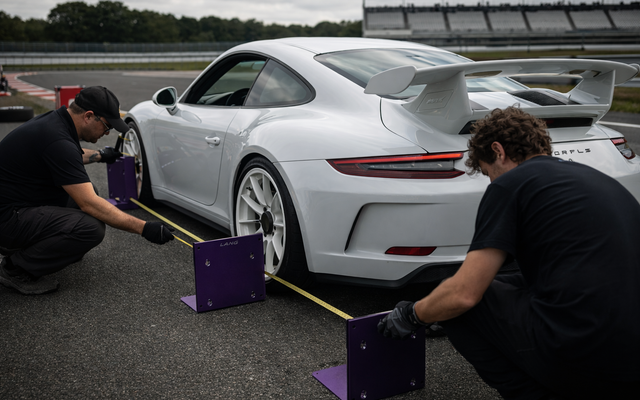
In the intensely competitive arena of today's pro-level drifting, victory is not merely solely a function of brute torque or pilot aggression. Conversely, it has evolved into a complex engineering challenge that demands a scrupulous fusion of choosing a time-tested chassis, arming it with the highest-quality competition components, and, most critically, comprehending its real-time characteristics on the course through advanced vehicle dynamics analysis tools. This definitive handbook functions as your master plan starting from the very first idea of a drift build through to the final telemetry-optimized tweaks that transform a capable vehicle into a consistent podium finisher. We will examine in detail the art and science of vehicle alignment optimization, illustrating how a advanced vehicle dynamics tool like GripDial eliminates guesswork and provides unparalleled insight into your vehicle's true performance.
The foundation of any great drift car is, without question, the base vehicle itself. Certain vehicles have earned legendary standing within the international drifting community due to their inherent balance, durable build quality, and the enormous ecosystem of performance parts available. Choosing the correct starting point is the first and most crucial selection a builder will make. For instance, the BMW's E36 3 Series is commonly accepted as perhaps the the greatest all-around drift cars of the modern era. Its near-perfect 50/50 weight distribution, coupled with a RWD configuration and robust straight-six motors, creates a car that is both easy to handle for newcomers and highly competitive in the hands of a pro competitor. The successor of this philosophy, the E46 model BMW, improves on these qualities with a even more developed structure, broader stance for improved confidence, and yet more lock directly from the OEM. A different dominant contender in the top-level arena is the Chevrolet Corvette C6.
This V8-powered sports car offers a particular combination of advantages to the sideways sport, including a light aluminum chassis, a transaxle-style gearbox and differential unit that aids in an perfect front-to-rear mass ratio, and the colossal torque of a large-displacement LS-series V8 engine. This blend makes it an absolute monster on track, able of entering and sustaining continuous angles with apparently easy application of power. For drivers looking for exceptional performance per dollar, the Nissan 350Z rises above as a top-tier choice. It arrives from the factory with a stiff body structure, a decent factory LSD, and the responsive VQ35DE engine that offers ample performance for learning and advancing in the activity. Its newer version, the 370Z model, presents further advancements in body strength, suspension design, and overall motor power, solidifying its position as a common pick among competitive drivers. Further legendary vehicles that merit mention include the lightweight Wankel-engined Mazda FC RX-7, the most popular Nissan S13 240SX, the torque-rich SN95 generation Mustang, the electronic-equipped BMW E90, and the compact yet unbelievably fun and teachable Mazda Miata. Every single one of these platforms gives a different set of traits, difficulties, and capabilities, but they all have in common the basic ingredients necessary to serve as a serious sliding vehicle.
However, picking the correct platform is only the beginning. To access the full performance of any of these vehicles, major upgrades to the steering and damping and springing systems are utterly non-negotiable. This is where the realm of performance aftermarket parts becomes sharp focus. The single most game-changing upgrade for a dedicated drift machine is the installation of a high-performance drift angle kit. These engineered systems, for example those manufactured by industry leaders like specialist manufacturers, are designed to dramatically expand the chassis's possible turning lock. A factory street car is highly limited in how far its tires can turn, a design trade-off for daily operation. In oversteer driving, conversely, maximum steering input is continuously necessary to manage and sustain a angle. An modification kit exchanges the stock hubs, linkages, and sometimes A-arms with parts that allow the steered wheels to reach steering lock over 70 or even 80 degs, compared to a average stock setting of around 40 to 50 °.
This vastly greater lock offers the operator with exponentially greater control during a drift, making it much more straightforward to start a oversteer moment, maintain it through a sweeping bend, and change smoothly from one angle to the other. The improvement in drivability is absolutely transformative. Paired with a correctly specified angle kit is the equally critical enhancement to the chassis's suspension. Store-bought or even expensive sport coilovers are simply not designed for the particular and extreme needs of sliding. A purpose-built pair of adjustable dampers is paramount. These specific coilovers have unique damping rates and spring rates that are optimized for the rapid weight transfer that is typical of sliding. When a operator starts a angle, the car's inertia is transferred violently to the outside of the turn. Proper drift-spec dampers handle this movement in a consistent fashion, enabling the chassis to stabilize promptly and giving the pilot precise feel through the steering wheel and driver's seat. They furthermore allow for exact adjustment of stance, rebound and compression rate, and corner weighting, which are all key elements of optimizing the vehicle's handling to a particular venue or driving technique. As a system, a top-tier drift angle kit and a properly selected set of competition coilovers constitute the absolute hardware base upon which all future refinement is built.
Once the essential parts is fitted, the subsequent essential phase in the project is the meticulous adjustment of the car's alignment. This is the world of vehicle alignment optimization, a process that can seem intimidating to the uninitiated but is, in practice, the defining factor to turning a assembly of fast pieces into a harmonious and controllable vehicle. The most discussed element of suspension geometry for oversteer is definitely camber. Wheel camber is the inclination of the wheel relative to the perfectly straight line when observed from the front-on of the car. When the top of the wheel is angled inward, this is referred to as negative camber. For drifting, inward-leaning wheels on the front axle tires is generally used and is considered necessary. The reason is deeply related to vehicle dynamics.
When a chassis is cornering at extreme sideways angles, the chassis rolls towards the external of the corner. This lean causes the outside front tire to reduce its best contact patch with the track surface. By applying inward lean, the tire is pre-leaned to account for this roll. As the chassis tilts into the corner, the outside front tire becomes more upright against the track, optimizing its bite at the exact point when it is needed most for steering authority. Typically, front axle angles for a dedicated drift machine vary from approximately -3 degrees to as high as -5 degrees or even more, based on the specifics of the chassis geometry, compound choice, and operator style. The rear axle tires also use inward lean, but the values are typically less and less aggressive than the front axle. Too much inward lean at the rear can make the car excessively prone to oversteer and hard to manage on power use, as it diminishes the effective contact patch of the driven tires during forward acceleration. Thus, rear camber settings are frequently in the range of -1 degree to -3 degrees, achieving a careful balance between giving sufficient lateral bite to help in starting and sustaining the drift while simultaneously preserving good hook-up for exiting the bend. Camber is merely one part of the more complex tuning picture, which also includes toe, self-centering steering, and steer correction adjustment.
Toe setting refers to the angle of the wheels when looked at from above. Inward toe means the front edges of the wheels are closer together than the trailing edges, while toe-out means the converse. For sliding, a modest amount of front axle toe out is frequently used to sharpen the turn-in steering response, making the chassis feel more agile and willing to initiate a oversteer moment. Rear axle toe setting is generally set to neutral or a very slight amount of inward toe to promote predictability under power. Caster is the longitudinal or aft inclination of the kingpin axis when observed from the lateral of the chassis. Increased caster enhances feedback and high-speed stability, and it furthermore boosts camber effect during turning, which is very beneficial. Adjusting these values is a complex dance where a modification to one parameter can and often will influence the others. The traditional method for tuning a chassis's alignment for competition has historically been a labor-intensive affair of trial and error. A pilot or engineering group would make a change based on a car suspension tuning hunch, test the vehicle on track, rely on the driver's individual feel and impressions, and then make an additional change. This cycle would iterate time after time until the vehicle felt "right" or the available track period ran out. This approach is not only exceptionally slow in terms of hours and tires, fuel, and parts, but it is additionally inherently inaccurate.
Driver sensation is a notoriously inconsistent measurement tool, colored by countless elements such as exhaustion, changing track surfaces, temperature, and merely the mindset of the pilot on that particular run. What feels "loose" on one pass might feel "pushing" on the following pass, leading to conflicting data and ineffective adjustments. This long-standing challenge in vehicle dynamics optimization is precisely where modern telemetry systems has made its mark to transform the process.
The advent and integration of specialized suspension tuning applications has ushered in a radically different paradigm for engineering and optimizing professional sliding vehicles. These platforms, represented by innovative solutions like data acquisition tools, function by actively measuring the actual mechanical behavior of the chassis as it is being driven on the circuit. Unlike relying on personal impression, these systems collect objective information on key factors such as damper compression and extension, individual tire rotation, lateral and longitudinal g-forces, wheel angle, and throttle and brake position. This collected telemetry is then processed by advanced applications that can graph drift suspension tuning guide and analyze the data in a clear format. For the first time, engineers and builders can see exactly what the vehicle is exhibiting at each millisecond of a lap. This ability changes the complete suspension tuning procedure. Think about the specific task of optimizing the front axle negative camber for a given car. Instead of applying a adjustment from -3 degrees to -3.5 degrees and then testing several runs to try and "sense" a change, a suspension tuning tool can deliver immediate and irrefutable feedback. The software can indicate graphically how the suspension's loading is acting during the most important stages of a drift: initiation, mid-corner, and changing direction. It can reveal if the existing angle is allowing the loaded tire to achieve maximum contact or if the tire is overloaded on its outer shoulder.
The tool can then make fact-based suggestions for change. Perhaps the data reveals that the outside front tire is still overworking its sidewall at -3.5 degrees of camber, implying that a move towards inward lean, say -4 degrees, might be advantageous. Conversely, the information might show that the tread is not achieving optimal operating temp or that the inner edge is wearing unevenly, which could indicate that there is too much angle and a slight lessening back to -3.2 degrees would be better optimal. This degree of granularity and useful insight was completely unimaginable in the era of exclusively manual adjustment.
The effect of employing a advanced drift telemetry system goes far beyond just setting camber. It serves as an essential suspension tuning guide that is specific to your exact vehicle. When setting the damping values on your coilovers, instead of depending on general guidelines or copying another team's numbers, you can employ the telemetry to observe how the car is performing in reaction to your adjustments. The software can display the wheel movement trace over a lap, showing if the coilovers are controlling the body movement properly or if they are permitting the vehicle to bounce uncontrollably after a transition. It can assist in diagnosing issues like excessive compression or losing droop, enabling you to introduce informed adjustments to spring preload, rebound/compression rates, or ground clearance. This process applies just as well to the detailed process of car alignment tuning. In addition to camber angle, the coilover setup tips software can provide insight into how adjustments to toe and caster are impacting the vehicle's stability during specific phases of a slide. For example, it can help you to determine the best amount of front toe out for your individual steering rack geometry and driving technique by measuring the quickness of initial response and the stability of the car at full countersteer. This turns the tool an incredibly useful performance optimization handbook that is constantly updated by the real-world performance of your personal chassis on the track. It shifts the whole project from a dark art into a methodical optimization exercise.
Moreover, the application of a system like modern telemetry is not confined to experienced teams with vast budgets. For the grassroots competitor, it serves as an amazing educational tool. It in essence offers the builder with the insight of a professional race engineer without the corresponding expense. It speeds up the development time by giving unambiguous directions to problems that would traditionally take years of experience to answer. A driver can learn how their particular car reacts to different adjustments, gaining a more intuitive comprehension of vehicle dynamics in the journey. It additionally opens up advanced performance tuning principles, enabling anyone with the desire to perfect their vehicle to achieve it in a systematic and effective manner. This is especially significant in a activity like drifting, where tuning knowledge has traditionally been a highly secretive commodity among elite teams. Today, that capability can be in the toolkit of every motivated enthusiast.
In conclusion, the journey to constructing and tuning the perfect championship-contending sliding vehicle is a multi-stage mission that seamlessly integrates classic mechanical wisdom with 21st-century telemetry solutions. It commences with the informed pick of a capable platform, followed by the installation of non-negotiable drift-spec hardware like high-performance angle modification systems and correctly specified drift-spec coilovers. The build then advances into the precision stage of alignment optimization, where values like camber, toe setting, and caster are meticulously configured to match the car's upgraded capabilities and the operator's personal style. Finally, and what genuinely separates the modern process from the traditional methods, is the integration of a sophisticated suspension tuning application. This platform eradicates the uncertainty and waste of solely subjective tuning by providing quantifiable, live telemetry on how the chassis is really functioning. It serves as an unparalleled diagnostic aid, a definitive alignment optimization handbook, and a all-in-one chassis development system. In unison, this holistic methodology ensures that all component of the competition vehicle—from the selection of the platform to the final adjustment on the coilover—is optimized for peak success on the circuit. It represents the complete evolution of the art of sliding, bridging physical pilot talent with precise chassis dynamics to create the ultimate dominant machines imaginable.